DESIGN
TECHNOLOGY
WEBSTACY®
© 2024 – 2026
Streamline your workflows, integrate your favorite tools, and eliminate repetitive tasks to scale efficiency.
Get in TouchAt Webstacy, we automate manual overhead and redundant tasks so your team can focus on what matters most. From data migration pipelines to internal tool connections, we engineer robust automated flows that save hundreds of hours weekly.
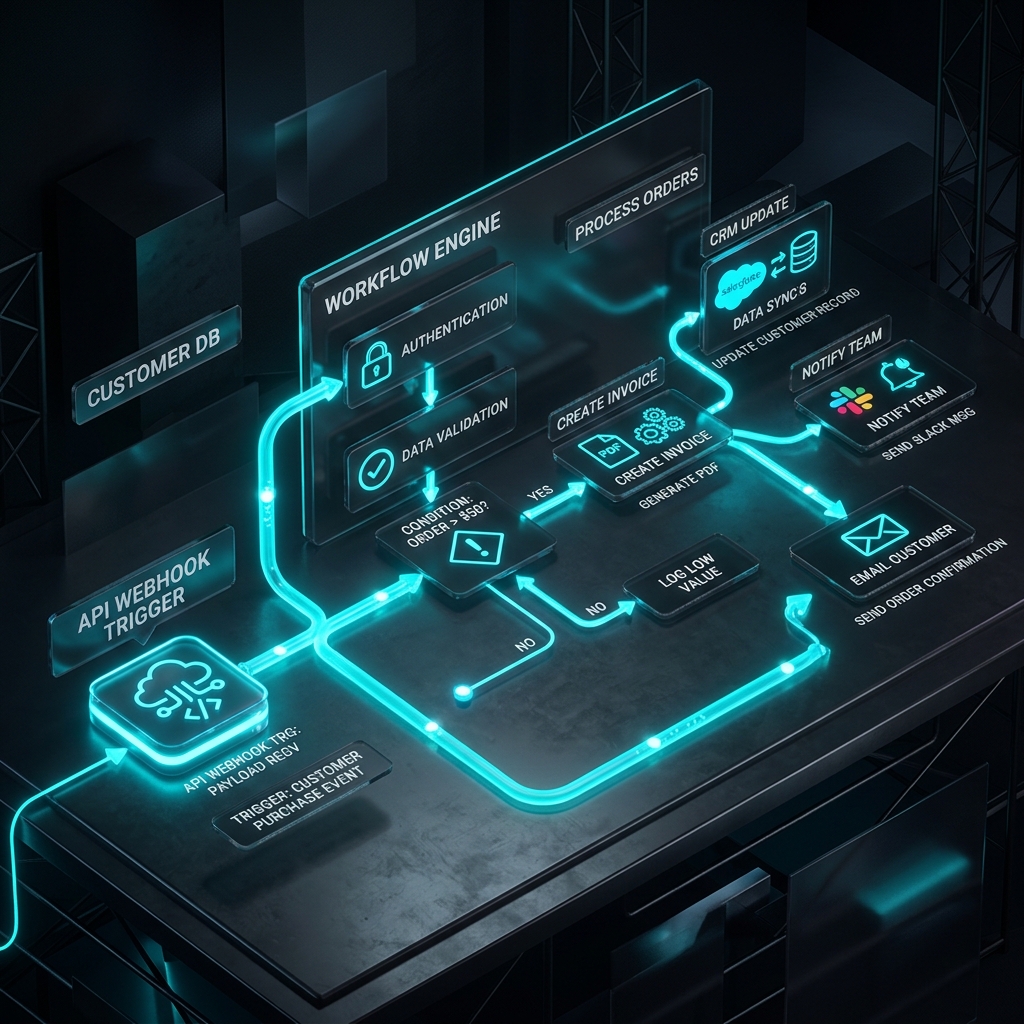

Turn hours of manual copying and processing into instant, zero-touch background tasks.
We implement secure API integrations, handling authentication and high volumes of data safely.
Error-handling, retries, and detailed event logging built-in to keep business workflows running 24/7.
Connect your website, CRM, communication tools, and databases into one source of truth.
We map out your current team workflows to find manual bottlenecks and repetition.
Selecting the best integration methods (APIs, webhooks, middleware) for your toolstack.
Building secure connectors, conditional logic, and data transformation scripts.
Testing automated sync runs with production-like data sets to ensure integrity.
Implementing retry loops and notifications for system exceptions or API outages.
Deploying automated flows and training your team on custom monitoring boards.
Every business reaches a point where growth is capped not by demand, but by how much manual work the team can absorb — copying leads between spreadsheets, chasing follow-ups by hand, re-entering the same customer data into three different tools. Business automation removes that ceiling. Instead of hiring to keep pace with repetitive tasks, you engineer the repetitive tasks out of the workflow entirely, freeing your team to spend time on the calls, decisions, and relationships that actually require a person.
| Task | Manual Process | Automated System |
|---|---|---|
| Lead capture | Form submission checked manually, entered into CRM by hand | Instant CRM entry, auto-tagged and routed on submission |
| Follow-up | Depends on someone remembering to call or email | Triggered sequences fire automatically on a schedule or event |
| Data sync | Copy-paste between spreadsheets and tools | Real-time sync across every connected system |
| Reporting | Manually compiled weekly or monthly | Live dashboards, always current |
| Error handling | Discovered only when something visibly breaks | Automated retries, logging, and alerts on failure |
Every engagement starts with an operational audit — mapping exactly where your team's time goes, and which of those tasks are repetitive enough to automate safely. From there we design the integration architecture (APIs, webhooks, or middleware depending on your existing toolstack), build the pipelines with proper error-handling and retry logic, and test against production-like data before anything goes live. Automations ship with monitoring in place, so a failed sync gets caught and resolved — not silently lost.
Automation delivers the clearest return for businesses with a repeatable process that's currently done by hand at volume: agencies chasing dozens of leads a week, service businesses juggling bookings across multiple channels, and operations teams maintaining data across tools that were never designed to talk to each other. If your team can describe a task as "the same five steps, every time," it's very likely automatable.
Standard automation follows fixed rules — if X happens, do Y. For workflows that require judgment (qualifying a lead's intent, summarizing a document, answering a nuanced question), we extend the same infrastructure with AI agents. See our AI-powered backend service for where that line sits, and our lead qualification playbook for a worked example combining both.
A single automated workflow — lead capture into your CRM with a WhatsApp follow-up sequence — is usually the fastest place to start. See the full breakdown in our guide to business process automation for small business.
30+ machines. Only 20 were ever booked. Now every single one works — across all of Coimbatore.
Case Study25 years in the field. Zero online presence. One system uncovered ₹1.4 crore that was already there
Case StudyHow PlotX closed a ₹73,00,000 sale with trust buyers believed, and a system that let no lead go quiet
Case StudyLakhs in deals were slipping through — not because interest faded, but because the team was busy with the wrong ones
Case StudyA brand-new brand. A brand-new store. 4,000+ products live from day one — with zero manual order chasing.
We build integrations across CRMs, websites, WhatsApp, email, spreadsheets, and most tools with an API or webhook — connecting them into one workflow instead of manual copy-paste.
No — it removes the repetitive, error-prone parts like data entry, follow-ups, and logging, so your team spends time on the calls and decisions that actually need a person.
Every pipeline ships with retry logic, error logging, and alerts, so a failed sync gets caught and resolved instead of silently losing data.
A single workflow, like lead capture into your CRM with WhatsApp follow-up, usually takes 2–4 weeks. Multi-system automations run longer depending on scope.
A single-workflow automation (like lead capture with follow-up) is priced as a fixed project based on the tools involved and complexity — you'll get a clear number before work starts, not an open-ended retainer.
No — automation connects to the tools you already use through their APIs or webhooks. The goal is to make your existing stack work together, not force a migration.
Yes — pipelines are built to be modified, not thrown away. As your workflow evolves we can adjust the logic without rebuilding the whole system from scratch.
East Bay SaaS startups are models of operational efficiency. Discover how custom Next.js integrations with HubSpot, Stripe, and automated webhook pipelines eliminate manual sales ops overhead.
Business AutomationManual data entry, delayed lead responses, and disjointed software cost US small businesses over $35,000 annually in lost productivity. Here is how to build resilient, automated operations.
Business AutomationStop letting unqualified leads fill up your sales team's calendar. Implement automated qualification pathways and sub-5-minute speed-to-lead workflows that screen leads before booking.
 webstacy