DESIGN
TECHNOLOGY
WEBSTACY®
© 2024 – 2026
Integrate smart agents, natural language processing, LLMs, and intelligent automation deep into your business core.
Get in TouchWe connect state-of-the-art cognitive models, LLMs, and vector search with your proprietary company data. From intelligent support agents to auto-generating documents, we build backend systems that execute complex logic in seconds.

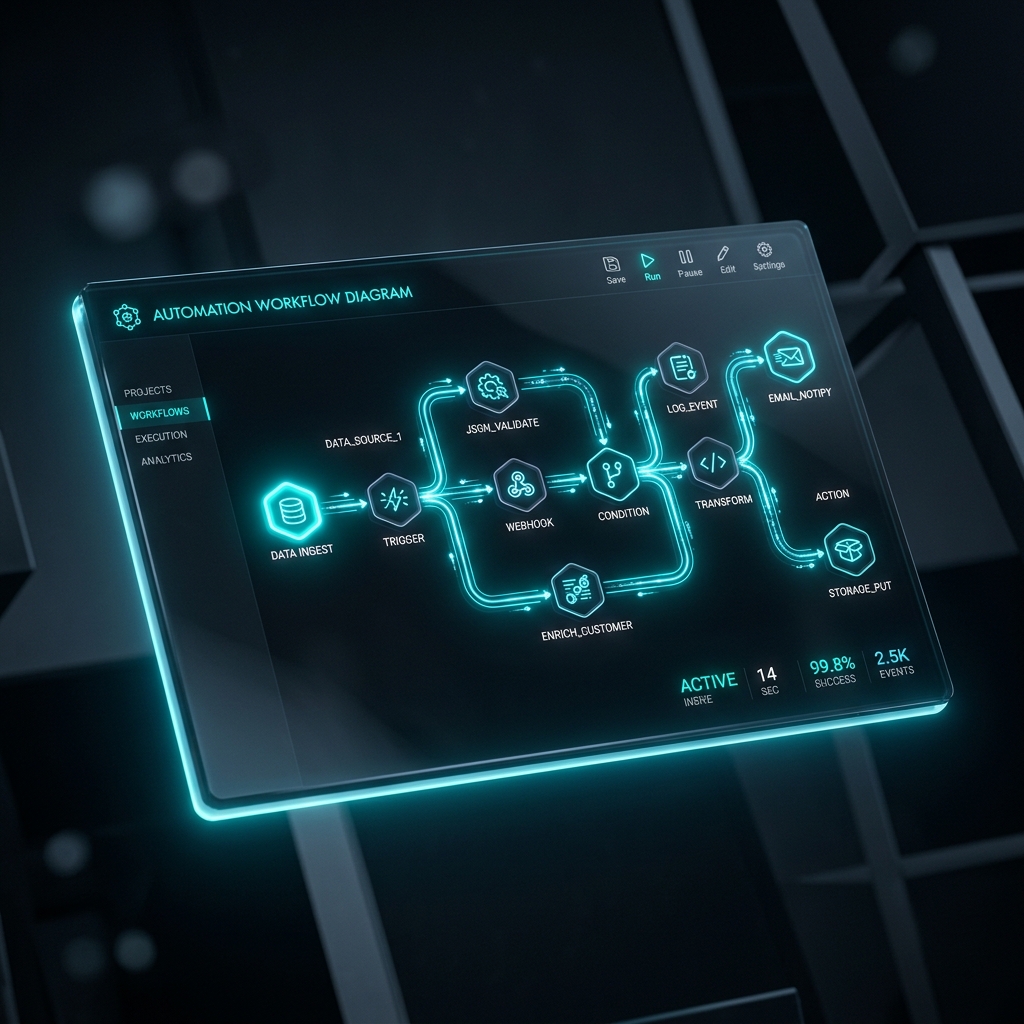
Custom LLM agents that query internal knowledge maps and resolve inquiries autonomously.
Lightning-fast semantic search engines that find matching assets, logs, or products instantly.
Dynamic report summarization, custom content writing, or automated email templates on the fly.
Simple API gateways that allow other applications to query your AI engines securely.
Outlining the tasks, models (OpenAI, Gemini, Anthropic), and data needs for your engine.
Converting documents, logs, or databases into search embeddings.
Crafting prompt templates, tool calls, and model constraints.
Implementing verification layers and strict filters for data confidentiality.
Exposing secure endpoints and building simple chat or dashboard front-ends.
Setting up streaming outputs and semantic cache buffers to keep response times under 1 second.
AI is genuinely useful for a narrower set of problems than the current hype suggests: tasks that require judgment across unstructured information — answering a nuanced customer question, summarizing a long document, or routing a request based on intent rather than a fixed rule. It's the wrong tool for anything that follows a fixed, predictable sequence; that's what standard automation (see our business automation service) already handles more cheaply and reliably. The value of AI-powered backend systems comes from applying them precisely where judgment is genuinely required — not bolting a chatbot onto everything.
| Factor | Rule-Based Automation | AI Agent |
|---|---|---|
| Best for | Fixed, predictable sequences (if X, do Y) | Judgment calls across unstructured input |
| Example | New form submission → add to CRM → send confirmation | Read an inbound email, determine intent, draft a relevant reply |
| Reliability | Deterministic, always behaves the same way | Probabilistic — requires guardrails and verification |
| Cost | Low, fixed | Scales with usage and model choice |
We start with feasibility mapping — defining the specific task, the right model for the job (OpenAI, Gemini, Anthropic, or others, chosen on merit rather than brand), and what data needs to feed it. From there, source documents and databases are converted into vector embeddings for retrieval-augmented generation (RAG), so the agent answers from your actual data instead of hallucinating. Prompt engineering and tool-calling logic define what the agent can and can't do, and every build includes verification layers and access controls before anything touches production data. The result is exposed through a simple API or a chat/dashboard interface, tuned for streaming responses and semantic caching so most interactions respond in under a second.
Connecting proprietary data to an AI system is a legitimate concern, and it's addressed structurally, not with a disclaimer: strict access controls, verification layers, and scoped permissions ensure confidential data never leaves its intended boundary. Because the architecture is built to be model-agnostic, you're never locked into a single AI provider — if a better or cheaper model becomes available, the system can switch without a full rebuild.
This service fits businesses with a genuine judgment bottleneck — high support ticket volume that a well-trained agent could triage, large internal knowledge bases that are slow to search manually, or lead qualification workflows that need more nuance than a simple rules engine provides. It's a poor fit as a first automation step; get the deterministic workflows automated first (see our business automation guide), then layer AI on top where judgment genuinely adds value.
For a deeper technical walkthrough, read our guide to AI agents for business backend integration.
From answering internal or customer questions using your own data, to summarizing reports and drafting content — the agent works from your proprietary knowledge, not generic answers.
We build on the model that fits the task and budget — OpenAI, Gemini, Anthropic, or others — and can switch providers without rebuilding the system.
Yes — every build includes verification layers, access controls, and strict filters so confidential data never leaks outside its intended scope.
We optimize for streaming outputs and semantic caching so most interactions respond in under a second.
Running costs scale with usage (API calls to the underlying model) rather than a flat license fee — we help estimate expected volume during the feasibility phase so there are no surprises.
Every build uses retrieval-augmented generation (RAG), meaning the agent answers from your actual documents and data rather than the model's general training — this dramatically reduces the risk of fabricated answers, and verification layers catch edge cases.
It's designed to handle the repetitive, well-documented questions so your team can focus on the complex or sensitive cases that genuinely need a person — not to replace human judgment entirely.
Palo Alto and Sand Hill Road are the epicenter of the artificial intelligence boom. To stand out among thousands of AI startups, your marketing website must provide an interactive, category-defining demonstration of your technology.
AI & AutomationPittsburgh is the global epicenter for autonomous systems, computer vision, and industrial AI. Discover how custom Next.js engineering translates complex algorithms into multi-million-dollar enterprise contracts.
AI & AutomationAI is moving far beyond basic chatbots. Discover how autonomous backend AI agents process documents, qualify leads, and execute complex business logic.
 webstacy