 webstacy
SaaS Conversion Audit: Want to benchmark your marketing site, Core Web Vitals, and demo funnel?
AI Agents for Business: Backend Integration Guide

Beyond Chatbots: The Rise of Autonomous AI Systems
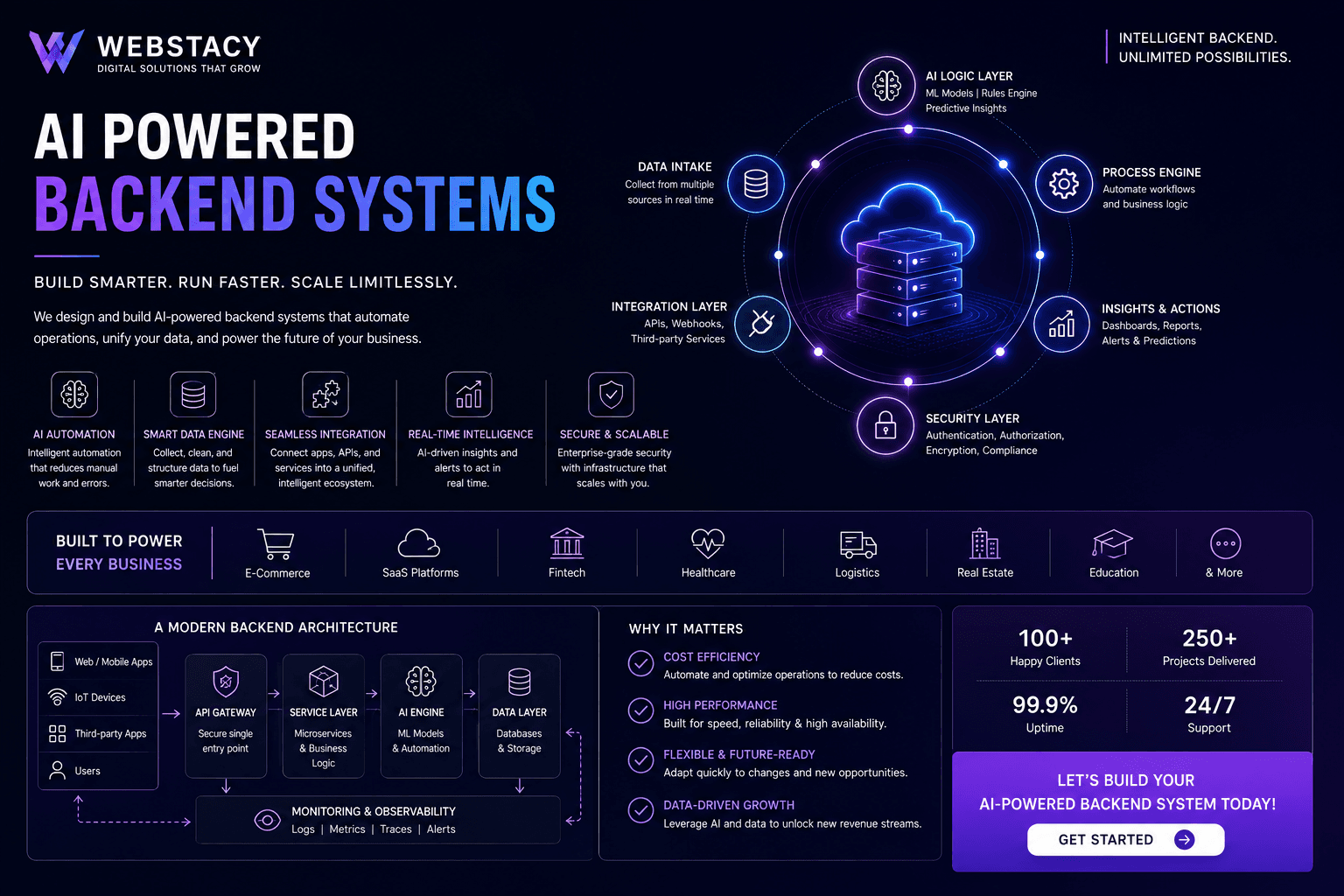
While consumer AI tools focus on conversation, enterprise AI delivers value behind the scenes. Intelligent backend agents can analyze incoming documents, extract unstructured data, execute database queries, validate information against compliance rules, and trigger external API calls automatically.
Core Use Cases for AI Backend Systems
1. Automated Document Processing & Extraction
Extract structured JSON records from invoices, contracts, identity documents, and receipts with 99%+ accuracy using vision-language models and structured output parsing.
2. AI-Driven Lead Scoring & Auto-Qualification
Evaluate incoming customer inquiries in real time against your target customer profiles. AI models score intent, enrich company data, and draft personalized response templates instantly.
3. Enterprise RAG Knowledge Bases
Allow your team and customers to query internal company documentation, technical manuals, and standard operating procedures (SOPs) using natural language with source-grounded answers.
Security & Governance in AI Architecture
At Webstacy, we prioritize enterprise data privacy. AI backend integrations are built with zero-retention data policies, sandboxed execution environments, and human-in-the-loop verification steps for critical operations.
See how these systems come together in Webstacy's AI-powered backend service.
What RAG Actually Means (and Why It Matters)
Retrieval-augmented generation (RAG) is the technique that keeps an AI agent grounded in your actual data instead of generating plausible-sounding but incorrect answers. Instead of relying purely on what a model learned during training, a RAG system first searches your own documents, database, or knowledge base for relevant information, then feeds that directly into the model's context before it generates a response. This is the difference between an agent that hallucinates a policy that doesn't exist and one that quotes your actual documentation.
| Approach | How It Works | Risk of Incorrect Answers |
|---|---|---|
| Base model only | Answers from general training data | Higher — no grounding in your specific data |
| RAG (retrieval-augmented) | Retrieves relevant data first, then generates | Lower — answers are grounded in real source material |
| RAG + verification layer | Adds a confidence/fact-check pass before responding | Lowest — flags uncertain answers instead of guessing |
Common Use Cases, Ranked by Implementation Complexity
- Simple: internal knowledge base search — semantic search over documentation, no generation required.
- Moderate: customer support agent answering from a defined knowledge base with escalation to a human for edge cases.
- Advanced: multi-step agents that call external tools (checking order status, updating a CRM record) as part of resolving a request.
Choosing a Model
Model choice should follow the task, not brand preference. For high-volume, well-defined tasks, smaller and cheaper models are often sufficient and dramatically reduce running costs. For complex reasoning or nuanced customer interactions, a larger frontier model earns its higher cost. A model-agnostic architecture means this choice can change over time as pricing and capability shift, without a system rebuild.
The businesses that get the most value from AI backend systems treat it as an extension of their existing knowledge and processes — not a replacement for having documented processes in the first place.
What "Guardrails" Actually Look Like in Practice
Responsible AI deployment isn't a single safety feature — it's layered controls at each stage of the pipeline.
| Layer | What It Does |
|---|---|
| Input validation | Filters malicious or out-of-scope requests before they reach the model |
| Retrieval scoping | Limits what data the model can access per request, based on user permissions |
| Output verification | Flags low-confidence or unsupported answers before they reach a user |
| Human escalation path | Routes edge cases to a person instead of forcing a guess |
Measuring Whether an AI System Is Actually Working
The right success metric isn't "does it sound intelligent" — it's task-specific: resolution rate without escalation, response accuracy against a known answer set, and time saved versus the manual process it replaced. Systems deployed without a clear measurement plan are difficult to improve, because there's no baseline to know whether a prompt change or model swap actually helped.
Cost Considerations Beyond the Model API
| Cost Component | What Drives It |
|---|---|
| Model API usage | Volume of requests and length of context per request |
| Vector database hosting | Size of your knowledge base and query volume |
| Infrastructure | Hosting for the API layer and any front-end interface |
| Maintenance | Keeping prompts and retrieval logic current as your data changes |
Starting Small: A Pilot-First Approach
Rather than building an AI system to handle every possible request on day one, the more reliable path is a narrow pilot — one well-defined use case, measured carefully, expanded only once it proves out. This limits the blast radius of any early mistakes, gives a real baseline for cost and accuracy before wider rollout, and builds internal trust in the system gradually rather than asking the business to bet everything on an unproven deployment.
Integrating AI Agents With Existing Software
An AI agent delivers the most value when it can act, not just answer — checking an order status directly in your systems, updating a CRM record, or triggering a downstream workflow. This requires secure, scoped API access into your existing tools rather than a standalone chat window disconnected from the rest of the business, and it's the difference between an interesting demo and a system that actually reduces workload.
Keeping the System Current as Your Business Changes
An AI agent trained against a snapshot of your documentation or data will drift out of date the moment your policies, pricing, or processes change — unlike static software, an AI backend needs a defined process for keeping its knowledge source current, whether that's an automated re-indexing pipeline or a scheduled manual review. Systems built without this consideration tend to degrade quietly, giving confidently outdated answers long before anyone notices the underlying data has moved on.
Internal Adoption: The Overlooked Success Factor
A technically excellent AI system fails if the team meant to use it doesn't trust or understand it. Involving the actual end users — support staff, operations teams — in defining what the system should handle, and being transparent about its current limitations, drives far better adoption than presenting a finished system top-down and expecting immediate trust.
AI backend systems work best layered on top of the fundamentals — start with Business Process Automation for Small Business (2026 Guide), and pair them with a Custom CRM & ERP Portal Development: 2026 Guide for a single source of truth.
Frequently Asked Questions
With proper architecture, yes — zero-retention data policies, sandboxed execution, and human-in-the-loop verification for critical actions keep AI agents from acting on sensitive data without oversight.
A chatbot answers questions; an AI agent takes actions — querying databases, processing documents, and triggering workflows autonomously based on defined rules and tool access.
Costs scale with complexity — a single-purpose agent (e.g., document extraction) can run a few thousand dollars, while multi-agent systems orchestrating several business processes cost significantly more.
We select per use case from leading providers including OpenAI, Anthropic (Claude), and Google (Gemini), often combining models with retrieval-augmented generation over your own company data.
Ai powered backend systems
Integrate smart agents, natural language processing, LLMs, and intelligent automation deep into your business core.
Ready to Scale Your SaaS Pipeline?
Schedule a strategy call with Webstacy. We will analyze your website, Core Web Vitals, and demo booking funnel to unlock compounding pipeline growth.