 webstacy
SaaS Conversion Audit: Want to benchmark your marketing site, Core Web Vitals, and demo funnel?
Scaling Google & Meta Ads ROAS in the US Market: 2026 Strategy
The Changing Paid Advertising Landscape Across the United States
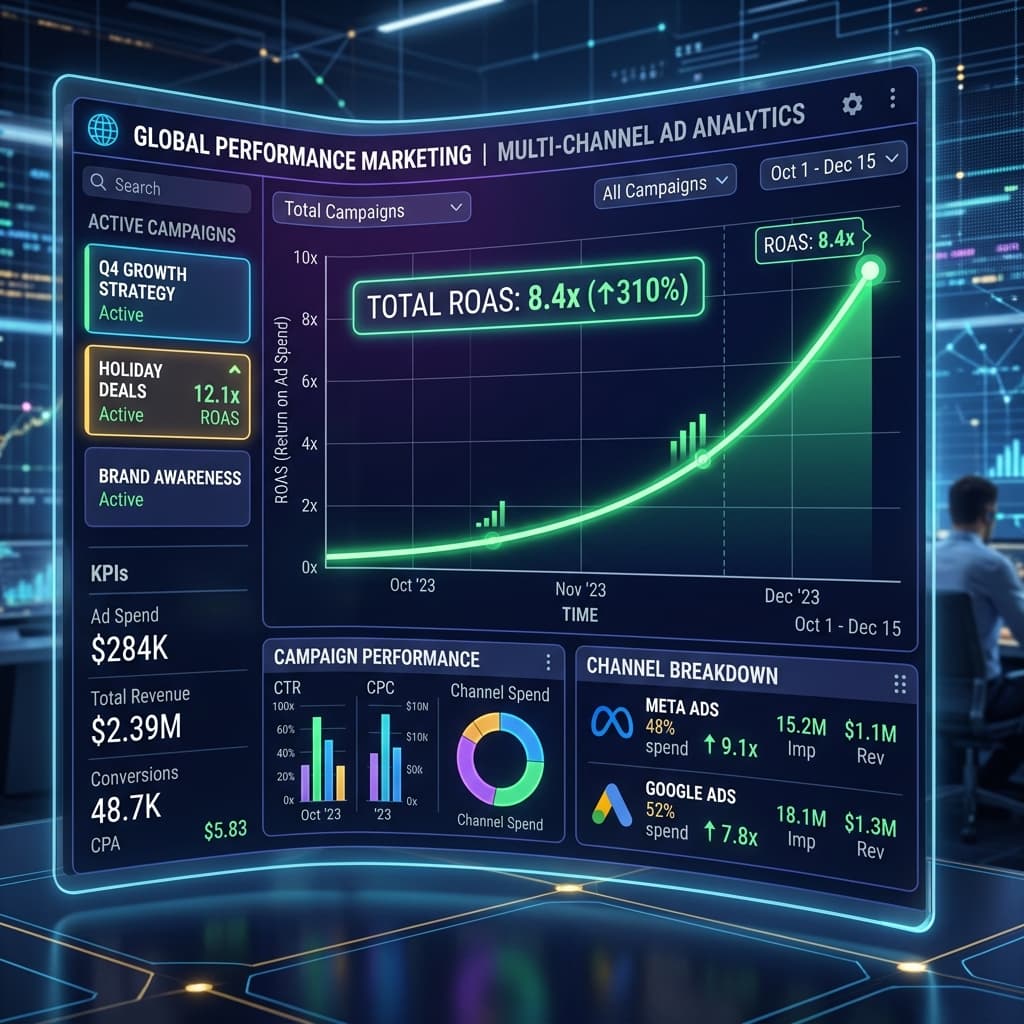
In the highly competitive US media buying landscape, cost-per-click (CPC) rates across Google Search, Local Services Ads (LSAs), and Meta Ads continue to rise year-over-year. Simply relying on platform auto-targeting without granular negative keyword lists, localized geo-fencing, and full-funnel attribution burns through ad spend with dismal return on ad spend (ROAS). Scaling profitably in 2026 requires a synchronized system connecting targeted ad creative, server-side data feeds, and high-converting custom landing pages.
1. Server-Side Conversions API (CAPI) Integration
Browser-based pixel tracking loses up to 30% of conversion data due to ad blockers and browser privacy restrictions. Implementing server-side Conversions API ensures 100% of event data feeds directly back to ad algorithms to optimize bidding.
2. Creative Diversification & Hooks
Test multiple ad angles, visual assets, problem-centric headlines, and video variations systematically to discover winning creative hooks that resonate with target sub-segments.
3. Dedicated Custom Landing Pages
Every ad campaign angle should link to a tailored landing page reflecting the exact headline, message, and offer promised in the ad creative.
Partner with Webstacy for Paid Growth
Our media buyers and conversion engineers build end-to-end paid growth engines through Webstacy's paid ads management service that deliver predictable, scalable Return on Ad Spend. Before scaling spend further, make sure your tracking setup is capturing the full picture.
The Formulas Behind Profitable Scaling
| Metric | Formula | What It Tells You |
|---|---|---|
| ROAS | Revenue ÷ Ad Spend | Return per dollar spent on ads |
| CAC | Total Acquisition Cost ÷ New Customers | True cost to win one customer |
| Break-even ROAS | 1 ÷ Profit Margin | Minimum ROAS to avoid losing money |
A campaign showing 3x ROAS can still be unprofitable if your margin is thin — always check ROAS against your actual break-even number, not an arbitrary industry benchmark.
A Practical Scaling Framework
- Prove it small: validate a winning audience/creative combination on a modest budget before scaling spend.
- Scale gradually: increasing budget too fast resets the platform's learning phase and often tanks performance temporarily.
- Diversify creative before diversifying budget: ad fatigue sets in faster than most advertisers expect — refresh creative on a set cadence.
- Separate scaling levers: test whether new audiences or increased budget on existing audiences drives better incremental return.
Why Most Scaling Attempts Fail
The most common scaling mistake is increasing budget on a campaign the moment it looks profitable, without accounting for diminishing returns — the first dollars of ad spend usually reach the highest-intent audience, and each additional dollar reaches a slightly less qualified pool. Sustainable scaling means monitoring CAC as spend increases, not just watching ROAS in isolation, and being willing to plateau a channel rather than force growth that erodes margin.
Creative Fatigue: The Silent ROAS Killer
Even a strong-performing ad degrades over time as the same audience sees it repeatedly — click-through rate falls, cost-per-click rises, and ROAS erodes even though nothing about the targeting changed. Tracking frequency (average number of times a user has seen the ad) alongside performance metrics reveals fatigue before it fully tanks results, giving time to refresh creative proactively rather than reactively.
| Signal | What It Indicates |
|---|---|
| Rising frequency, falling CTR | Creative fatigue setting in |
| Stable frequency, stable CTR | Healthy, sustainable delivery |
| Sudden CPC spike with no targeting change | Increased auction competition, not a creative issue |
Attribution: Why the Platform's Number Isn't the Whole Picture
Ad platforms tend to over-report their own contribution to a sale, especially across multi-touch customer journeys. Cross-referencing platform-reported ROAS against actual revenue in your CRM or analytics — not just the ad dashboard — gives a more accurate picture of true profitability, and prevents scaling a channel that looks good in isolation but is actually cannibalizing conversions from another source.
Budget Allocation Across the Funnel
| Funnel Stage | Typical Budget Share | Goal |
|---|---|---|
| Cold / prospecting | 50–60% | New audience discovery |
| Retargeting | 25–35% | Convert warm, previously-engaged visitors |
| Lookalike / expansion | 10–20% | Scale beyond the initial proven audience |
These are starting proportions, not fixed rules — the right split depends on sales cycle length and how much retargeting inventory a given audience size actually supports.
When to Pause a Campaign vs. Optimize It
Not every underperforming campaign needs more optimization — sometimes the underlying offer, audience, or market fit simply isn't there yet, and continued spend just delays a decision that should be made sooner. A useful rule: if a campaign hasn't shown any positive signal after enough spend to exit the platform's learning phase, it's worth pausing and re-testing the core offer or audience rather than tweaking bids indefinitely.
Seasonal and Market Fluctuations
ROAS and CAC naturally shift with seasonality, competitor activity, and platform-wide auction pressure — a campaign that performed well last quarter can underperform this quarter for reasons entirely outside your control. Benchmarking performance against your own historical data, rather than a fixed external target, gives a more accurate read on whether a campaign genuinely needs optimization or is simply moving with the broader market.
The Learning Phase and Why Patience Matters
Every major ad platform runs a "learning phase" after a campaign launches or is significantly edited, during which the algorithm is still gathering data on who converts. Performance during this window is typically less stable and less representative of a campaign's true potential — pausing or drastically editing a campaign too early, based on a few noisy days of data, is one of the most common reasons advertisers give up on channels that would have worked with a few more days of patience.
Cross-Platform Budget Coordination
When running Meta and Google simultaneously, the two platforms don't coordinate with each other — a visitor exposed to both can be claimed as a conversion by each, inflating apparent combined performance. Reviewing blended CAC across all channels together, rather than trusting each platform's individually reported number, gives a more honest read on true acquisition cost.
The businesses that scale ad spend most successfully treat every dollar as a hypothesis to be tested, not a guaranteed multiplier — that mindset is what separates durable growth from a short-lived spike followed by a costly correction.
Ultimately, sustainable scaling is a discipline of small, measured increases paired with constant monitoring — not a one-time budget decision made and forgotten.
Traffic is only half the equation — pair this with Conversion Rate Optimization: Turning Traffic Into Revenue to make sure the clicks you're paying for actually convert.
Frequently Asked Questions
Google Ads averages around 3.7:1 and Meta closer to 2.2:1 across industries — but 'good' depends on your margins; a 2:1–4:1 range is typical for most advertisers to stay profitable.
Common causes include creative fatigue (the same ad shown too many times), rising CPCs from increased competition, or broken tracking after a privacy update — audit your Conversions API setup first.
It depends on intent — Google captures people actively searching (higher intent, higher cost), while Meta builds awareness among people who aren't searching yet but fit your audience (lower intent, lower cost).
Server-side Conversions API tracking sends conversion data directly from your server instead of relying on browser pixels, recovering the ~30% of data typically lost to ad blockers and privacy restrictions — yes, you need it in 2026.
Paid Ads Management
Maximize return on ad spend (ROAS) with hyper-targeted campaigns across Meta, Google, and TikTok.
Ready to Scale Your SaaS Pipeline?
Schedule a strategy call with Webstacy. We will analyze your website, Core Web Vitals, and demo booking funnel to unlock compounding pipeline growth.